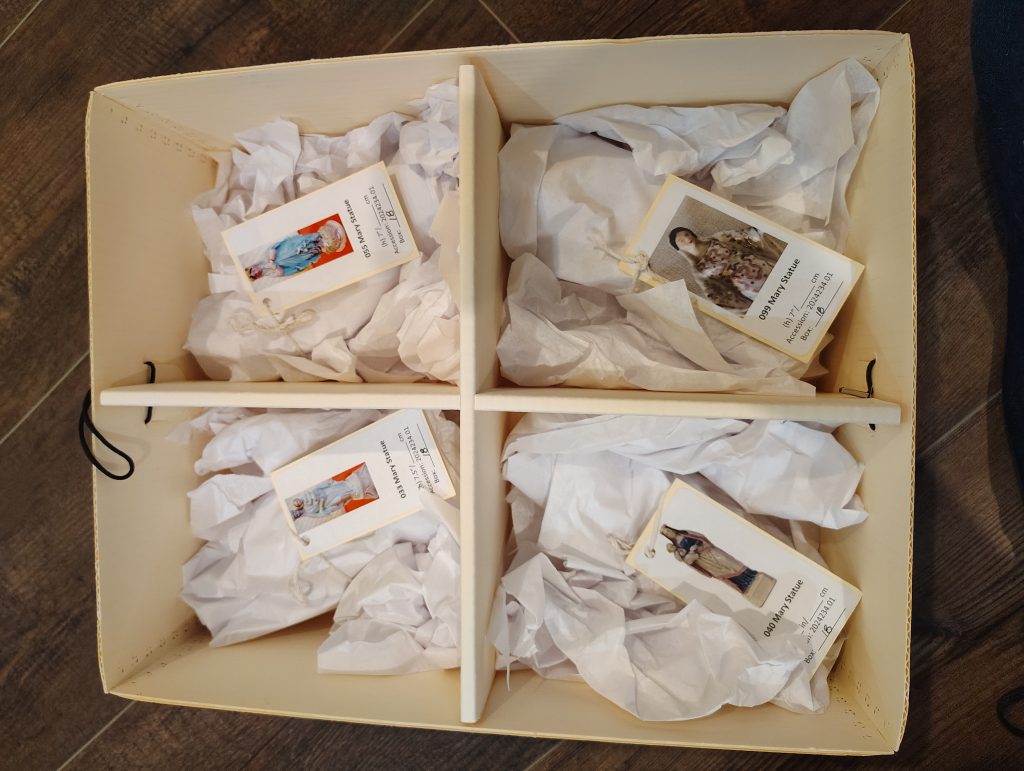
Every once in a while, a donation request turns out to be a true treasure trove. Such a thing happened in January. The donor, Bonnie MacDougall, was seeking a home for her collection of statues of the Blessed Virgin Mary. An admirer of Our Lady’s feminine grace, Ms. MacDougall has amassed over a hundred statues throughout her lifetime. Some she quietly dedicates to family or friends in need of special assistance. Others she has given away to admirers drawn to specific depiction of Mary. Until a couple weeks ago, the collection has watched over her home.
Although the Shrine is separately incorporated from the Diocese, it lacks the staff time to evaluate potential artifact donations and the space to store collections not on display in its Museum. This is where it partners with the Diocesan Archives. We serve as the Shrine Museum’s Registrar, documenting and storing artifact not on display. With the help of Autumn, the Museum Coordinator, we assess and recommend potential donations to the Museum collection. The Archives then receives, catalogs, and stores all Shrine donations. We also keep track of artifact loans, both items from our collection to other institutions and loans of artifacts from other institutions. The Shrine’s artifact collection and the Diocesan artifact collection are available to Autumn Wolter, the Museum Coordinator, to plan exhibits, outreach activities, and events.
How do Loan agreements work? The Shrine Museum has a number of objects on exhibit at the moment, including archaeology from recent digs uncovered on the property and owned by University of Florida. Donated to The Executive Director signed a loan agreement.
I made an initial visit to Ms. MacDougall’s house to evaluate the collection. While the collection contains many well-known representations of Mary (like Our Lady of Lourdes), Ms. MacDougall has also amassed some lesser-known ones, such as Our Lady of Pontmain (France). The statues vary in size from 5 to 28 inches tall and are made of porcelain or ceramic. Some are hand-painted, and many feature gold gilding. I knew immediately that this collection was special and pilgrims to the Shrine would benefit from it. And so, this brings us to a couple weeks ago.
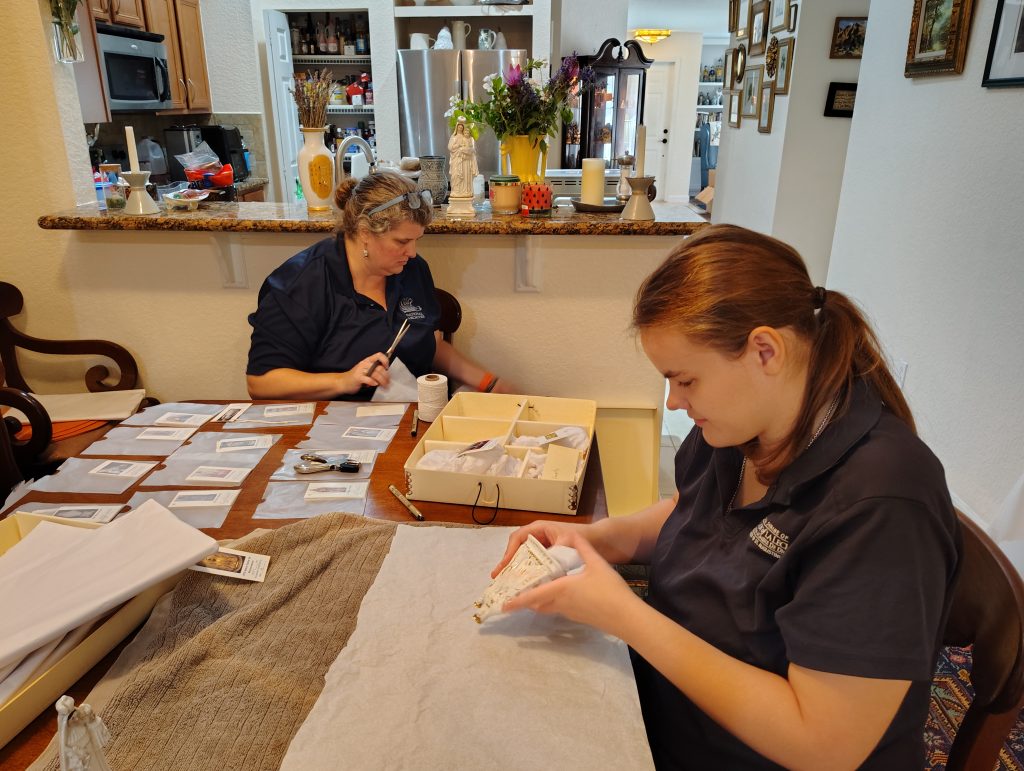
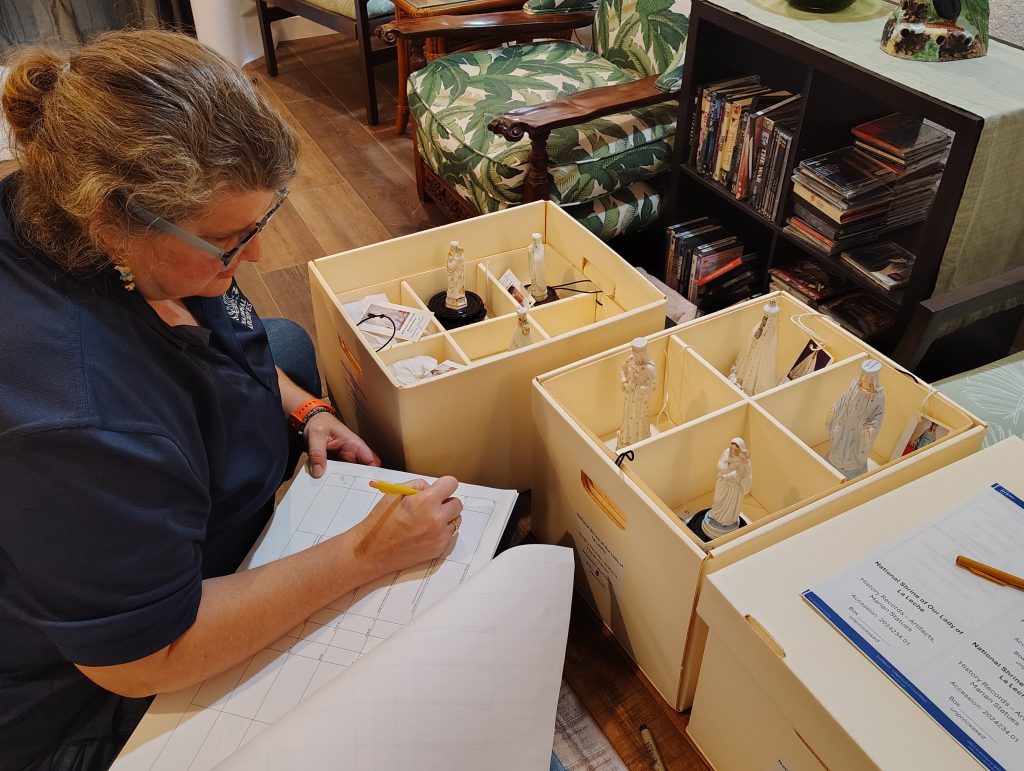
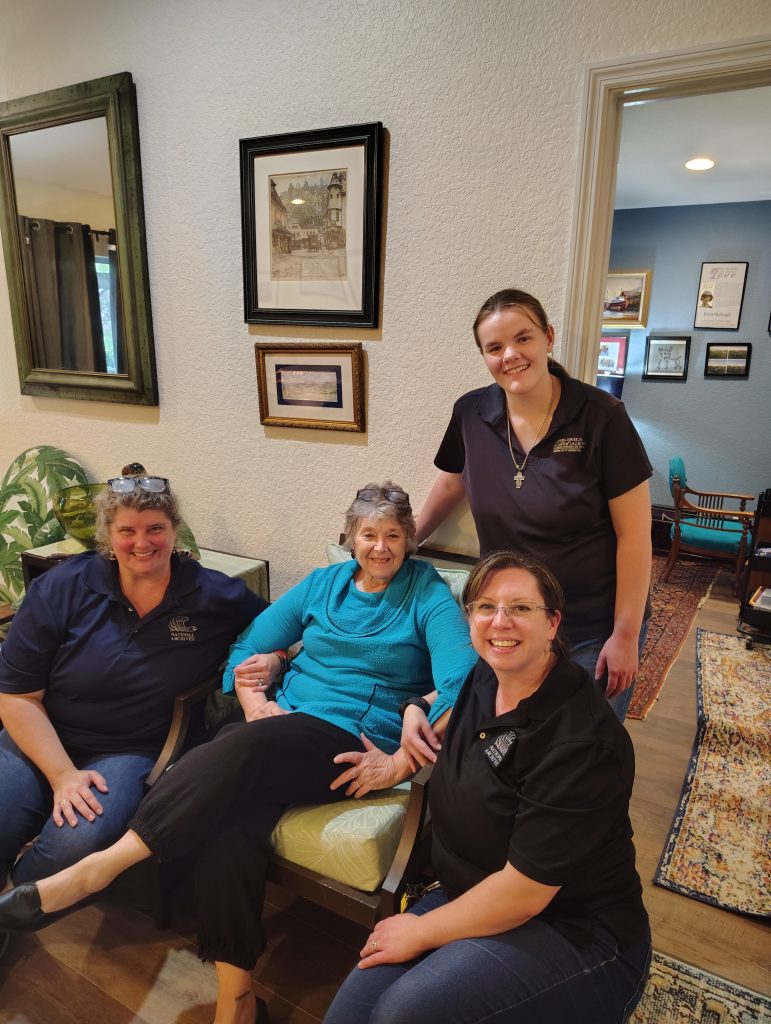
On a Tuesday, Autumn Wolter (the Museum Coordinator), Laura Adams (my other Archives team member), and I drove to Vero Beach in a rented van filled with archival boxes of various sizes, trays, and plenty of archival tissue. We prepared for the packing extravaganza by transforming Ms. MacDougall’s list of statues into label tags with photos and descriptions. This made the process more efficient and helped us accurately track the multitudes of Mary received that day. Autumn took responsibility for carefully wrapping most of the statues, ensuring they would survive the drive north. Laura and I
alternated tasks: checking off statues from our list; selecting the appropriate size trays for them; and recording which statues went into each box. Ms. MacDougall served as the fourth member of our team, matching tags to statues. Our day started at 9 am and we departed at 7:15 pm in a van loaded with 27 boxes of precious statues. It was a long day but absolutely worth it!
I look forward to planning a future event at the museum, where Ms. MacDougall’s collection of Marian statues will be displayed for the first time.